Self Storage Appraisal: How Your Facility Gets Valued, and What Moves the Number
Economic occupancy, not physical occupancy, is what gets capitalized. Here is the rest of what the appraiser is actually working from.

Written by: Miles Davison
Data validated by: Storeganise team
Published: 1 November 2026
Updated: 1 November 2026
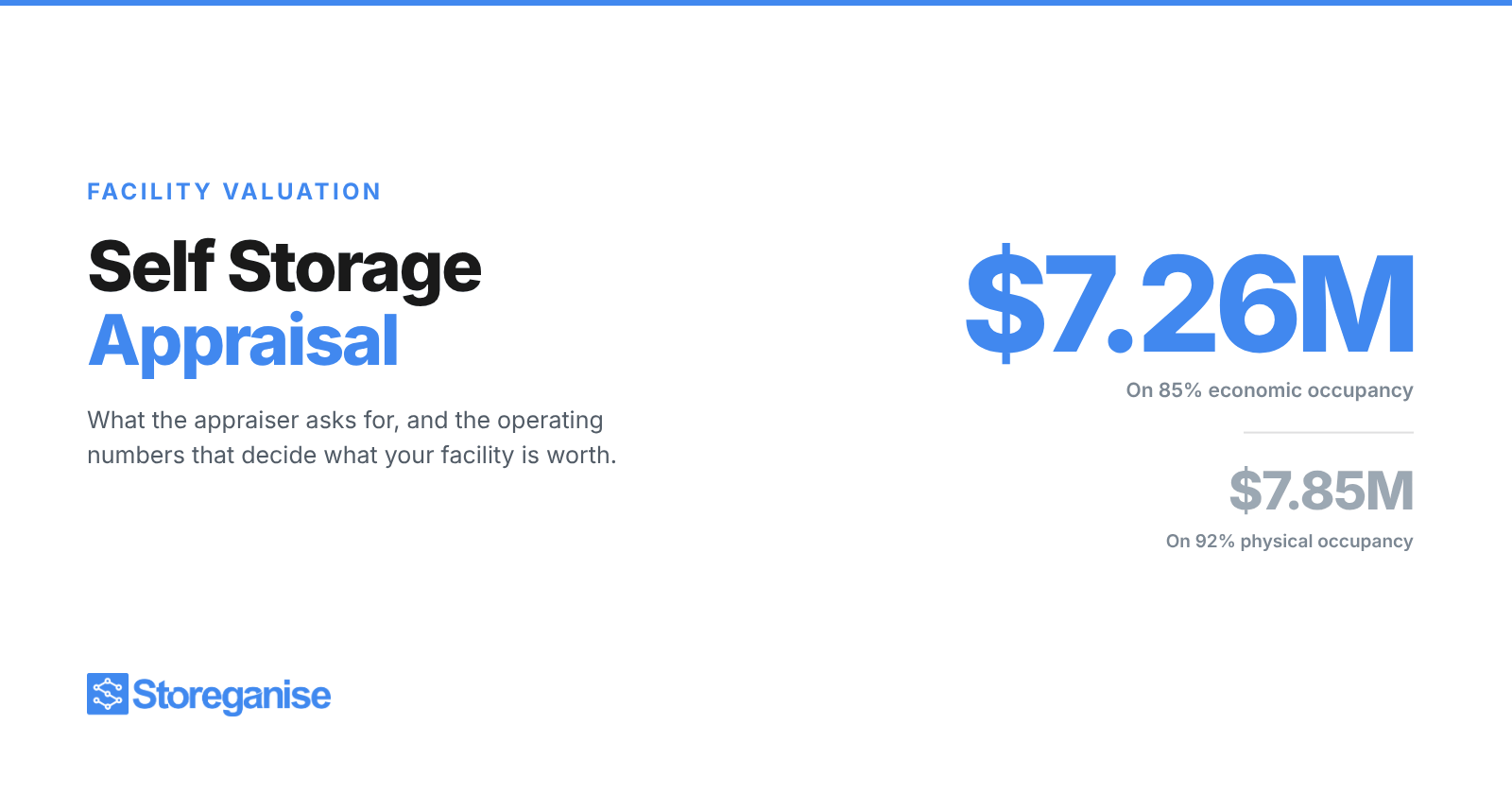
What a self storage appraisal is, and when you need one
A self storage appraisal is an independent opinion of market value, prepared by a qualified appraiser to a professional standard, and supported by your own operating records. It is not an estimate, a broker's view, or an online calculator. Someone examines what your facility actually earns and produces a defensible number.
You will need one when a lender is underwriting a loan or a refinance, when a sale is under contract, when a partner is bought out, when an estate is settled, or when you are contesting a tax assessment.
The thing most operators get wrong is assuming the appraiser arrives with a number in mind. They do not. They arrive with a document request, and the quality of what you hand back shapes both how long it takes and how conservative the result is.
Key takeaways
- The income-capitalization approach decides the number on almost every stabilized facility. The other two approaches check it.
- Your cap rate is a market input you do not control. Your expense ratio and economic occupancy are inputs you do.
- Economic occupancy is what gets capitalized, not the physical occupancy figure on your dashboard. The gap between them is worth real money.
- The appraiser will ask for a rent roll, trailing operating statements and occupancy by unit type. How fast you produce those sets the timeline.
- An MAI designation and a state appraiser licence are different things. One is a prerequisite for the other.
- A US appraisal and a RICS Red Book valuation are different instruments and are not interchangeable.
Who performs one, and what the credentials mean
In the United States, the baseline is a state credential. A Certified General Real Property Appraiser is licensed to appraise commercial property of any type and value, and that is the licence your lender will check.
Above that sits the MAI designation from the Appraisal Institute, and the two are often confused. The state credential is a prerequisite for the MAI, not the same thing. On top of it, a candidate completes a standards course, a fair housing course and a business practices and ethics course, passes exams in advanced income capitalization, advanced market analysis and highest and best use, advanced concepts and case studies, and quantitative analysis, then passes a General Comprehensive Exam, completes a General Demonstration of Knowledge, and logs 4,500 hours of specialized experience.
Whether you need that depth comes down to who is reading the report. A local lender refinancing a single stabilized facility may be satisfied with a Certified General appraiser who knows the market. An institutional lender, a portfolio transaction or a contested valuation is a different conversation.
Ask any candidate how many self storage facilities they have appraised in the last two years, and in which markets. Self storage is an operating business wearing a building, and an appraiser who mostly values retail strip centers will reach for the wrong comparables.
The three approaches, and which one sets your number
Appraisers work with three approaches and then reconcile them. They are not averaged.
The cost approach values the land, adds the depreciated cost of the improvements, and arrives at what it would take to replace the facility today. It matters most for a new build, which is where a feasibility study does the heavier lifting, or for a unique property or an insurance question. On a stabilized facility it is usually the weakest indicator, because nobody buys a storage business for the value of its concrete. Our construction cost guide covers the inputs this approach runs on.
The sales comparison approach looks at what similar facilities actually sold for, usually expressed as price per rentable square foot or as a multiplier on effective gross income. It is a reality check. Its weakness is that genuinely comparable self storage sales are thin in most markets, and adjusting across markets introduces judgment fast.
The income-capitalization approach is the one that decides the number. It converts what the facility earns into what the facility is worth. In its simplest form, net operating income divided by a market cap rate. For a facility still leasing up, or one with a known step change coming, a discounted cash flow over a holding period of around ten years does the same job with more moving parts.
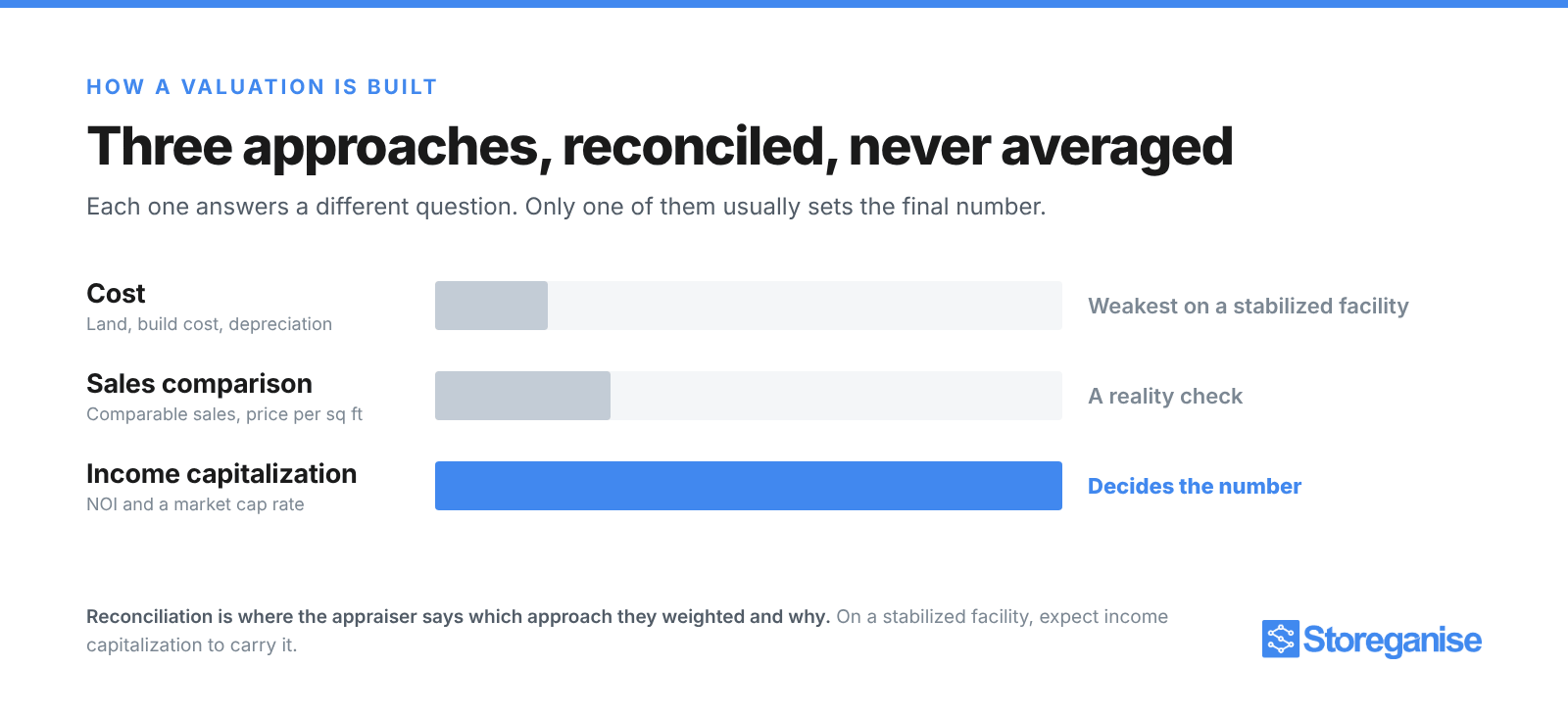
Reconciliation is where the appraiser says which approach they weighted and why. On a stabilized facility, expect income capitalization to carry it.
What the appraiser will ask you for
This is the part operators underestimate. Here is the request, and what each item is actually feeding.
| Document | Approach that consumes it | Why it moves the number |
|---|---|---|
| Rent roll, current, by unit | Income | Establishes in-place rent against street rate |
| Occupancy by unit type | Income | Shows which sizes carry the revenue |
| Economic occupancy | Income | This is what gets capitalized, not physical occupancy |
| Operating statements, three years trailing | Income | Trailing actuals, never a pro forma |
| Expense detail by line | Income | Sets the expense ratio, the lever you control |
| Ancillary income detail | Income | Commonly 2% to 5% of gross income |
| Concession and credit loss history | Income | Folds into the long-term vacancy factor |
| Rentable square footage and unit mix | Sales comparison | Drives price per square foot |
| Site plan and building specifications | Cost | Reproduction cost less depreciation |
| Capital expenditure history | Cost | Separates effective age from actual age |
| Survey, title and zoning documents | All three | Confirms what is being valued |
Most of the top half of that table lives in your management platform rather than your filing cabinet. In Storeganise, the unit and rental export covers the rent roll for one site or across all sites with selectable fields, each site's financials dashboard carries utilization alongside physical occupancy, and every income type can carry its own accounting code so protection, late fees, admin fees and retail report separately from rent. Exports run to CSV and Excel, and everything in reporting is reachable through the API.
Two honest limits are worth planning around. Occupancy by unit type is a current view rather than a historical series, so if the appraiser wants the lease-up curve by size you will need to have been capturing it. And Storeganise reports revenue, not expenses, which sit in your accounting software. You are producing one half of the operating statement, not all of it.
How to read the appraisal report
Four things to find before anything else.
The effective date. Value is stated as of a specific day, which is often not the day the report lands. A report with an effective date three months back is describing a facility that may have moved since.
The scope of work. This states what the appraiser did and did not do. It is where you find out whether anyone inspected the units or worked from documents alone.
Extraordinary assumptions and hypothetical conditions. These are the conditions the value depends on. "Assumes the facility achieves stabilized occupancy of 90%" is doing enormous work in a valuation, and it belongs in your reading, not in the fine print.
The reconciliation. Which approach the appraiser weighted and why. If income capitalization was weighted and your trailing financials were thin, that tells you where the conservatism entered.
The operating numbers that move the valuation most
Three inputs decide most of the outcome, and you control two of them.
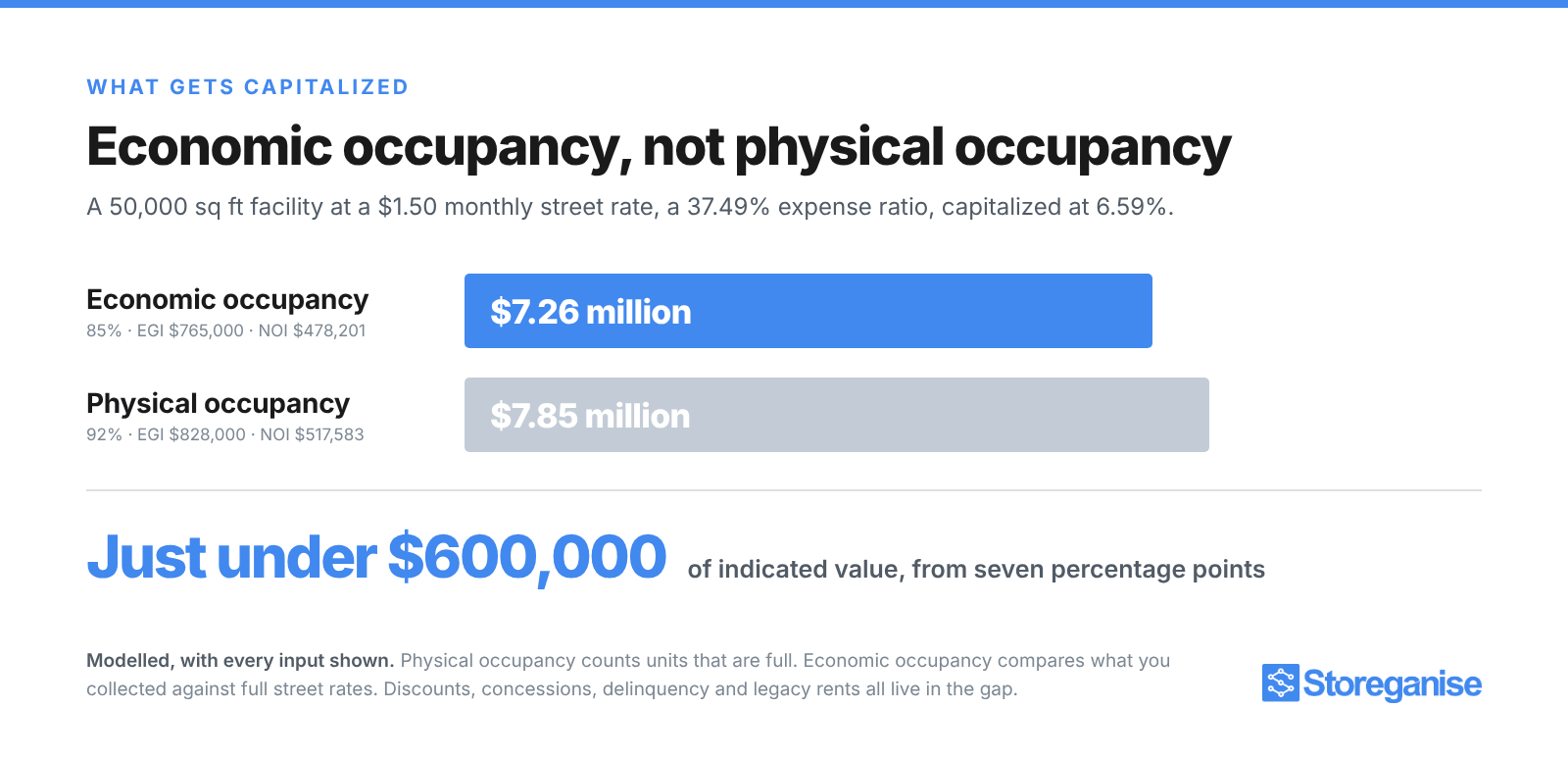
Economic occupancy, not physical. Physical occupancy counts units or square feet that are full. Economic occupancy compares what you actually collected against what you would have collected at full street rates. Discounts, concessions, delinquency and below-market legacy rents all live in the gap. The appraiser capitalizes the second number.
Here is what that gap is worth. The example below is modelled, using our own figures with every input exposed.
Take a 50,000 square foot facility at a $1.50 per square foot monthly street rate, which gives potential gross income of $900,000 a year. Physical occupancy is 92%, economic occupancy is 85%. Apply a 37.49% expense ratio and capitalize at the 2026 sector average cap rate of 6.59%.
| Capitalized on | Effective gross income | Operating expenses | NOI | Indicated value |
|---|---|---|---|---|
| Economic occupancy, 85% | $765,000 | $286,799 | $478,201 | $7.26 million |
| Physical occupancy, 92% | $828,000 | $310,417 | $517,583 | $7.85 million |
Just under $600,000 of difference, from seven percentage points that many operators treat as a rounding error. This is a modelled example, not a market observation, and the expense ratio is a published figure rather than yours.
The expense ratio. Operating expenses as a share of effective gross income. This is the input you most directly control, and it compounds: every dollar of expense you remove is a dollar of NOI, which is roughly fifteen dollars of value at a 6.59% cap rate.
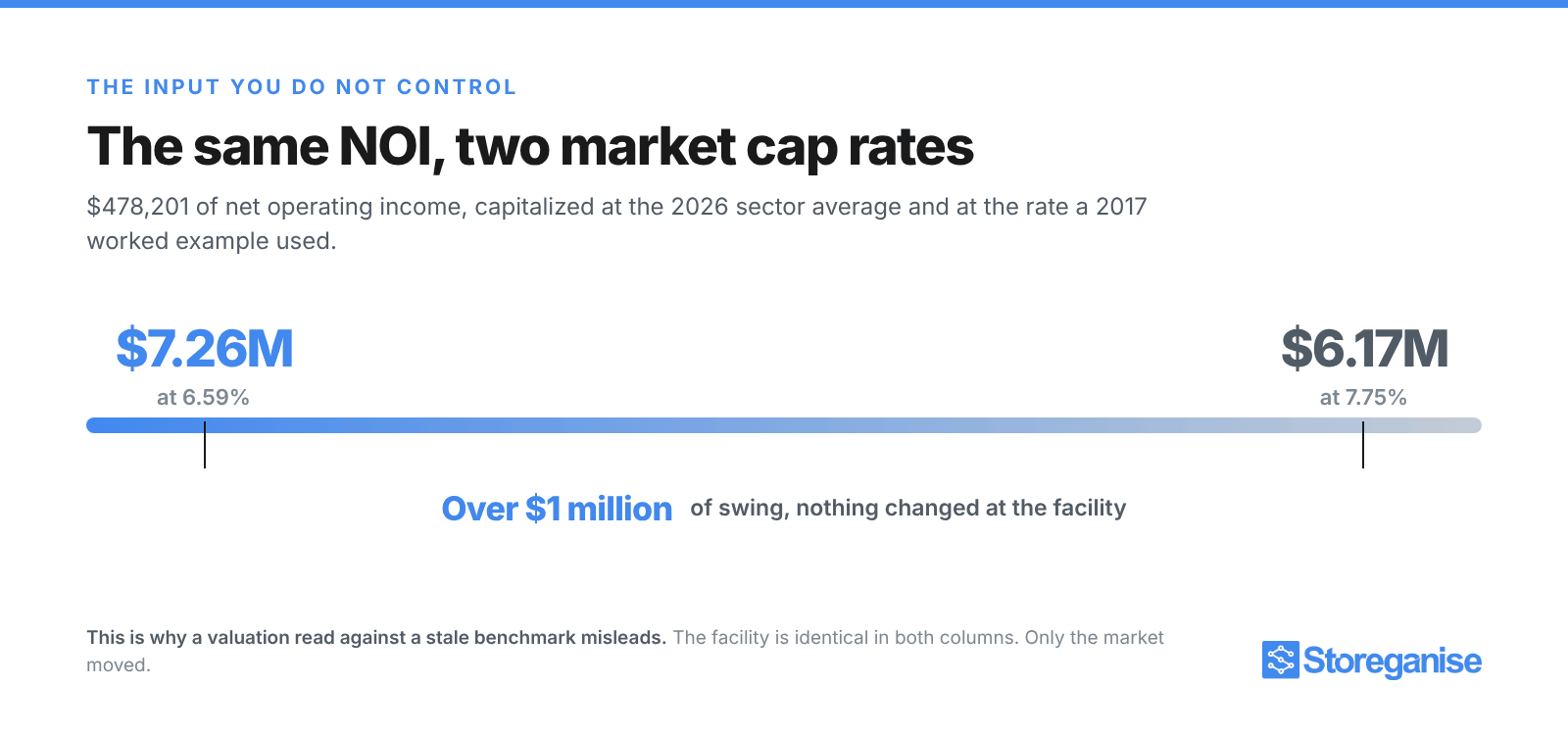
The cap rate, which you do not control. It is set by the market, and it moves. A facility throwing off $478,201 of NOI is worth about $7.26 million at 6.59%. The same NOI at 7.75% is worth about $6.17 million. More than a million dollars of swing, with nothing changed at the facility. That is why a valuation read against a stale benchmark is worse than useless.
Occupancy by size, revenue per square foot by size, and income by category are the readings that feed all three, and our reporting and analytics tools produce them by unit type.
How long a self storage appraisal takes, and what drives the cost
The LightBox Lender Appraisal Index put the national average turnaround for lender-driven commercial appraisals at 13.3 days in the first quarter of 2024, down from 13.7 the previous quarter and 14.0 a year earlier. That figure covers commercial property of all types rather than self storage specifically, and it is a 2024 reading, so treat it as a sense of scale rather than a quote.
On cost, every figure we could find sits on an appraisal firm's own marketing page, which is a vendor quoting its own prices. Rather than repeat a number we cannot stand behind, here is what actually drives it: the scope of work, whether the report is a full narrative or a restricted appraisal, the complexity of the asset, how many comparable sales exist in your market, and how quickly you supply the documents.
That last one is in your hands. An appraiser waiting three weeks for a rent roll is an appraiser billing for the wait.
If the number comes back lower than you expected
Start by separating two things, because only one of them is actionable.
A disagreement with the conclusion is not a basis for anything. An appraiser who weighed the evidence and reached a number you dislike has done their job.
A factual error in the inputs is a different matter, and it is usually an error in something you supplied. Wrong rentable square footage. A unit mix that does not match the site. A rent roll that predates a rate increase. Capital expenditure that was never disclosed, so the improvements were depreciated as older than they are. Ancillary income buried inside rent instead of broken out, so a revenue line went missing. Each of those is correctable, and each traces back to the document request rather than to the appraiser's judgment.
Comparable selection sits between the two. You can reasonably ask why a particular sale was included or excluded, and a good appraiser will explain the adjustment. You are asking a question, not lodging an objection.
The pattern underneath all of this is the same. The number is built from what you handed over, so the quality of your records is not an administrative detail. It is an input to the valuation.
Appraisal outside the United States
Almost everything above assumes a US appraisal, because that is what the published guidance covers. Across the 50-plus countries we work in, the instrument is often different.
RICS members valuing outside their home country work to the Red Book Global Standards. Valuing in the United States adds requirements on top, so the work complies with USPAP, which RICS describes as the recognized ethical and performance standard for the appraisal profession in the USA.
The practical point for an operator with facilities in more than one country is that a valuation and an appraisal are not interchangeable documents just because both produce a number. Ask the party requesting it which standard they need the report prepared to, and ask before the work starts rather than after.
Two other things travel badly. The US comparable set is thin in markets where few facilities trade, which pushes weight onto the income approach. And multi-storey urban conversions, which dominate outside the US, carry a different net-to-gross profile than the drive-up layouts most US comparables assume, which our facility design guide covers in detail.
If you are earlier than this and still deciding whether to buy at all, our guide to investing in self storage covers the due diligence that comes first, and our management software keeps the records an appraiser will eventually ask for.
Sources
- Christian Sonne, The Self-Storage Appraisal Process: Understanding Valuation Approaches Used Today, Inside Self-Storage, 28 November 2017
- Appraisal Institute, MAI Designation requirements
- LightBox Lender Appraisal Index, Q1 2024, as reported by VRA Commercial
- RICS, Practical considerations for RICS valuers operating in the USA
FAQs
What is a self storage appraisal?
An independent opinion of market value, prepared by a qualified appraiser to a professional standard and built from your own operating records. Lenders require one for a loan or a refinance. Buyers, partners settling a buyout, estates and tax appeals use them too. It is not a broker's estimate or an online calculator.
How long does a self storage appraisal take?
The LightBox Lender Appraisal Index put the national average for lender-driven commercial appraisals at 13.3 days in the first quarter of 2024, across all commercial property types rather than self storage specifically. How quickly you supply the rent roll and trailing financials is the part of that timeline you control.
What is the difference between an appraisal and a broker opinion of value?
An appraisal is prepared by a licensed appraiser to a professional standard, and it is what a lender will accept. A broker opinion of value is a broker's view of likely sale price, usually faster and cheaper, and often produced free. They are not interchangeable documents for underwriting.
What cap rate do appraisers use for self storage?
A market-derived rate rather than a fixed one. It comes from comparable sales, investor surveys and the facility's own risk profile. The 2026 sector average is 6.59%. A facility carrying lease-up risk, thin comparables or a secondary location is capitalized at a higher rate than the average.
What documents does an appraiser need from the operator?
A current rent roll by unit, occupancy by unit type, three years of trailing operating statements, expense detail by line, ancillary income, concession and credit loss history, rentable square footage and unit mix, site plans, capital expenditure history, and the survey, title and zoning documents.
Does physical or economic occupancy decide the valuation?
Economic occupancy. Physical occupancy counts units that are full. Economic occupancy compares what you actually collected against full street rates, and the appraiser capitalizes the second. On a modelled 50,000 square foot facility, seven percentage points between the two was worth just under $600,000 of indicated value.